
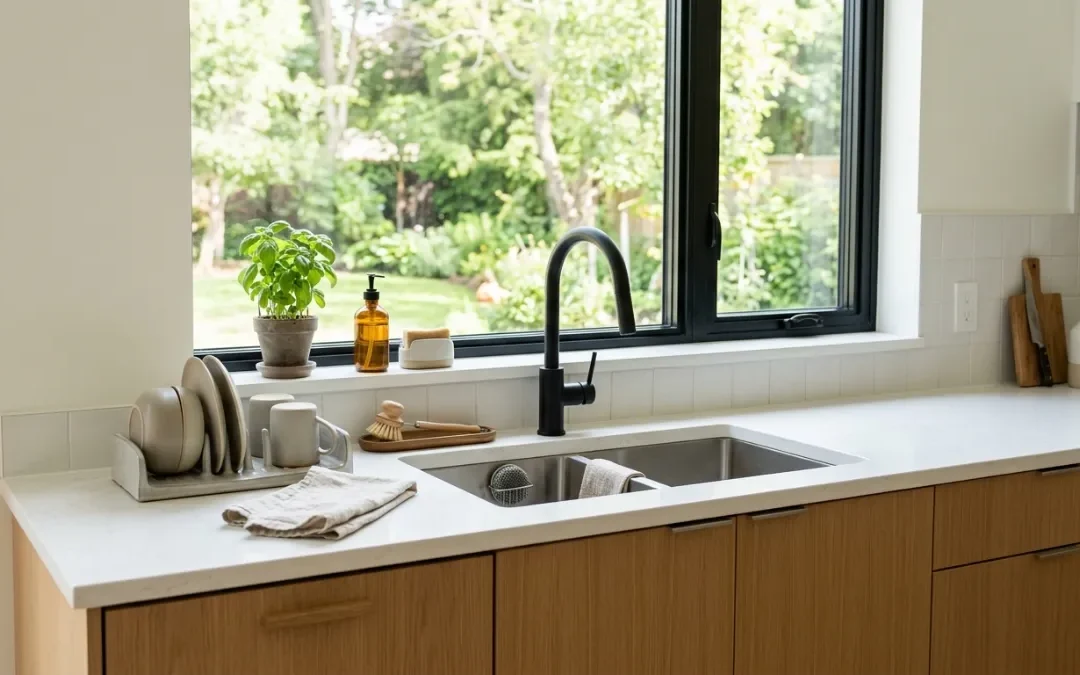
The kitchen faucet is one of the most used fixtures in your entire home. On average, a kitchen faucet is turned on and off anywhere between 8 and 15 times per day, adding up to thousands of uses per year. That makes the faucet decision much more than an aesthetic one. It is a practical, long-term investment in something you will interact with every single day.
The right faucet makes washing produce, filling pots, rinsing dishes, and cleaning the sink feel effortless. The wrong one — the one that always drips, that has a spray radius that soaks your shirt, or that already looks dated three years after installation- becomes a minor daily frustration that adds up over time. Here is what to consider before you buy.
Start With Your Sink Configuration
Before you look at any faucet styles, know your sink. The number of pre-drilled holes in your sink or countertop determines which faucets you can actually install without modification.
A single-hole sink configuration is the most flexible because it works with most modern single-handle faucets and can accommodate a deck plate that allows three-hole faucets to be installed over a single hole. A three-hole configuration is common in older sinks and opens up options for two-handle or bridge faucets. A four-hole configuration often accommodates a separate side spray or soap dispenser alongside the main faucet.
If your sink configuration and your faucet preference do not match, it is usually possible to drill additional holes or use an escutcheon plate to bridge the gap, but it is better to know this before you buy rather than after.
The Main Faucet Types and How They Perform
Pull-Down Faucets
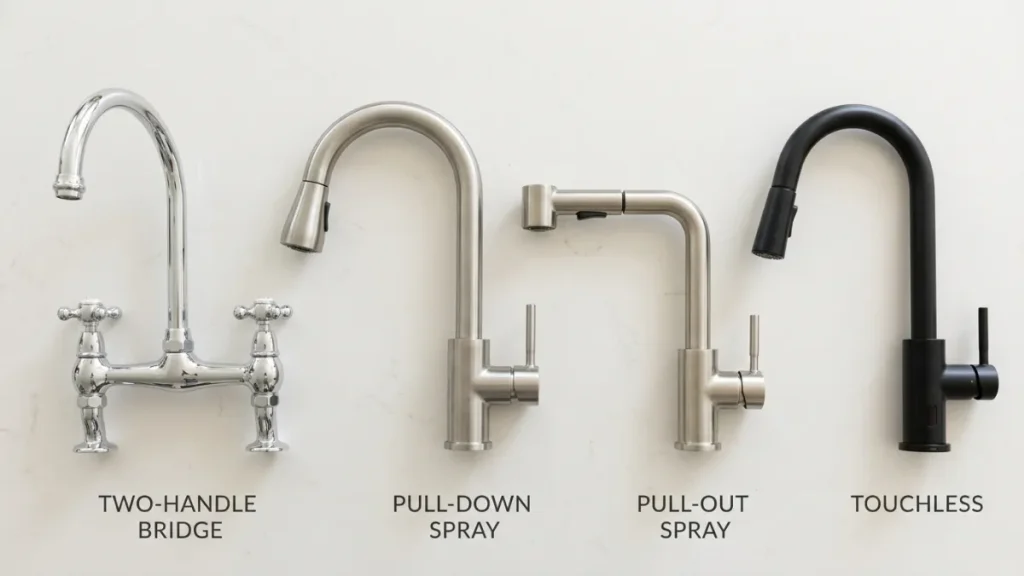
The pull-down faucet has a high arc spout with a spray head that pulls straight down into the sink basin. It is the most popular kitchen faucet style today and for good reason: the high arc makes it easy to fill tall pots, the pull-down head gives you excellent control over where the water goes, and the retractable hose snaps back into place magnetically on most quality models.
Pull-down faucets work best with deep, single-basin sinks where there is enough basin depth to accommodate the spray head without splashing. In a shallow or divided sink, the pull-down head can be awkward to use comfortably.
Pull-Out Faucets
The pull-out faucet has a lower-profile spout and a spray head that pulls forward and out toward you rather than downward. This makes pull-out faucets a better fit for kitchens with lower overhead clearance, for sinks positioned under cabinets with limited vertical space, or for homeowners who find the high arc of a pull-down faucet visually too dominant in a smaller kitchen.
The trade-off is that pull-out faucets typically have a shorter hose reach than pull-down models, which can make tasks like rinsing the full surface of a large sink or filling a pot outside the sink more cumbersome.
Bridge Faucets
The bridge faucet connects two separate handles to the spout with a horizontal bridge, creating a more traditional, plumbing-exposed silhouette. It is a particularly popular choice in farmhouse-style kitchens, traditional kitchens, and any space where a more vintage or artisanal aesthetic is the goal.
Bridge faucets are functional and beautiful, but require a three-hole sink configuration and take up more visual real estate on the deck than a single-handle option. For homeowners who love the look, they are absolutely worth it.
Touchless and Touch-Activated Faucets
Touchless and touch-activated faucets have moved from novelty to a genuinely practical option over the last decade. The technology is significantly more reliable than it was in its early iterations, and the ability to turn on water with the back of a flour-covered hand or a wrist when your hands are full is a real everyday convenience that many homeowners say they cannot imagine cooking without once they have experienced it.
The main consideration is battery life and sensor sensitivity. Look for models with high-quality sensor systems and easy battery access, and check that the sensitivity can be adjusted to avoid accidental activations.
Choosing a Finish That Lasts
The finish on your faucet does two things: it defines the visual character of the fixture, and it determines how well the faucet holds up over years of daily use.
Brushed brass and matte gold have dominated kitchen faucet design for the better part of a decade and continue to be strong choices for warm, classic, and transitional kitchens. They pair beautifully with white or cream cabinetry and natural stone countertops.
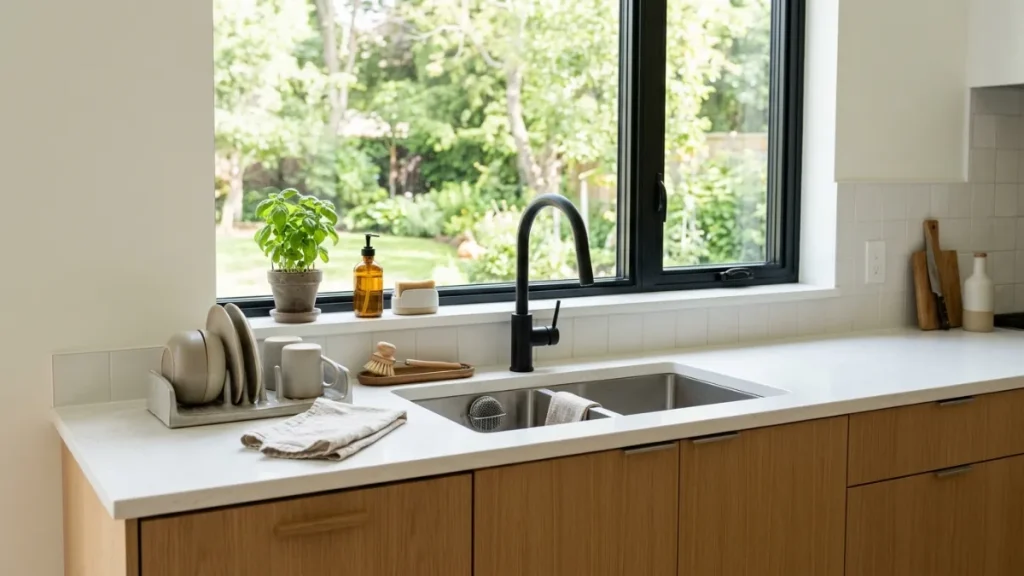
Matte black is a bold, graphic choice that has proven more staying power than many trend watchers predicted when it first rose to prominence. It works particularly well in modern and industrial kitchens and hides water spots and fingerprints better than most other finishes.
Brushed nickel and chrome remain the most versatile finishes in kitchen faucets. Brushed nickel has a warmer undertone that works across most design styles, while chrome is cooler and more contemporary. Both are widely available across every price point.
Whatever finish you choose, look for faucets with a PVD (Physical Vapor Deposition) coating rather than a standard electroplated finish. PVD finishes are significantly more resistant to scratching, tarnishing, and the gradual wear of daily cleaning. Most quality faucet brands now offer PVD options across their product lines.
Spout Height and Reach: The Practical Details
Two measurements that most buyers overlook until after installation are spout height and spout reach.
Spout height determines how much clearance you have between the faucet spout and the bottom of your sink basin. For filling large stock pots or tall water bottles at the sink, a high-arc spout (8 inches or taller) is genuinely useful. For kitchens with low overhead cabinets directly above the sink, a lower-profile spout is necessary to avoid clearance conflicts.
Spout reach determines how far into the sink basin the water stream falls. A spout with too little reach will direct water at the front edge of the basin, causing splashing. A spout with too much reach will hit the back of the basin. The ideal reach places the water stream roughly at the center or center-rear of your sink, which minimizes splash and maximizes convenience.
Most faucet product listings include both measurements. Check them against your specific sink dimensions before you buy.
What to Spend
Kitchen faucets span an enormous price range, from under $100 to well over $1,000 for premium European brands. In this category, price tracks closely with quality in terms of internal valve durability, finish longevity, and the solidity of the mechanism over years of use.
For a kitchen that will be used daily by a family, a budget of $200 to $450 from a reputable brand (Kohler, Moen, Delta, Grohe, or Brizo) will get you a genuinely high-quality faucet with ceramic disc valves, a quality finish, and a lifetime warranty on most components. Spending significantly less than this range typically means compromising on the valve quality or finish durability. Spending significantly more gets you into designer territory, where you are paying for aesthetics and brand prestige as much as additional performance.
The Faucet Is a Detail That Earns Its Prominence
In a well-designed kitchen, the faucet is one of the first things people notice when they look at the sink wall. It is also one of the most consistently touched surfaces in the room. Choosing one that looks beautiful, feels solid in your hand, and works exactly the way you need it to every single time is absolutely worth the thoughtfulness that decision deserves.
Get the practical details right first: sink holes, spout height, reach, and mechanism type. Then choose the finish that ties the whole design together. And if you are ever unsure about compatibility or installation, a qualified kitchen remodeling contractor can help you make the right call before you commit to anything.